

The Question Isn’t “Why Build Green?” Anymore.
It’s: “Why Would Anyone Build Anything Else?”
Not long ago, “building green” was dismissed as a niche choice, something reserved for eco-enthusiasts or companies chasing awards. But the world has changed. Climate risk, rising energy prices, and investor pressure have pushed sustainability from optional to essential. Today, green building isn’t a trend; it’s the new foundation of responsible, resilient, and profitable development.
The question has flipped. It’s no longer “Why build green?”
It’s “Why would anyone build anything else?”
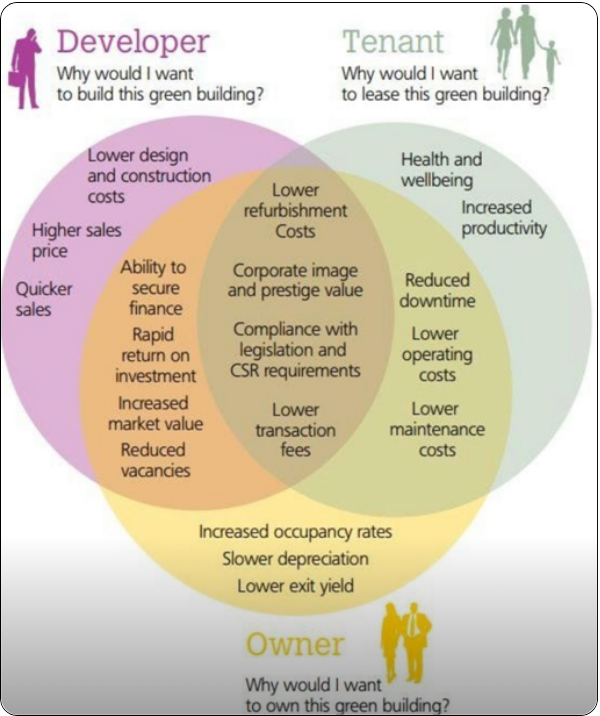
The Triple Win: Developers, Tenants, and Investors
Green buildings create value at every level of the real estate ecosystem — from blueprint to long-term asset management.
- For Developers:Smart planning and integrated design reduce waste, optimize material use, and streamline construction. LEED- or IGBC-certified projects often achieve faster approvals and higher sales premiums — sometimes up to 8–10% higher market value compared to conventional buildings.
- For Tenants:A sustainable workspace is a healthier, more productive one. Access to daylight, improved indoor air quality, and temperature comfort have been proven to enhance employee well-being and cognitive performance. Studies show workers in green-certified buildings report up to 26% higher productivity and 30% fewer sick days.
- For Owners & Investors:Green buildings maintain higher occupancy rates, command stronger rents, and experience lower operational risk. As ESG reporting becomes mandatory across global markets, sustainable assets are emerging as the only truly future-proof
In short, green building design doesn’t just “feel good” but it performs better on every measurable metric.
Beyond Eco-Friendly: Economically Smart & Socially Responsible
The old belief that sustainability means sacrificing returns is long gone. Today, building green is synonymous with building smart.
- Operational Efficiency:Through energy-efficient HVAC systems, renewable power integration, and water reuse, green buildings can cut operating costs by 20–40%. That’s not just saving money — it’s building resilience against volatile utility prices.
- Occupant Health and Well-Being:The link between indoor environment quality and human health is undeniable. Access to fresh air, non-toxic materials, and natural lighting contributes directly to better physical and mental health outcomes.
- Global Compliance & Finance:Governments and financial institutions are aligning around sustainable standards. Projects aligned with LEED, WELL, or BREEAM certifications are increasingly eligible for green bonds, tax incentives, and low-interest sustainability loans.
- Corporate ESG Goals:For companies reporting under GRI or CDP frameworks, green buildings offer tangible, quantifiable proof of environmental responsibility — helping attract top talent, loyal customers, and ethical investors.
Building green has evolved from being a moral imperative to an operational advantage.
The Future Is Already Here
Around the world, the real estate industry is pivoting to a low-carbon, high-performance model. Cities like Singapore, Copenhagen, and Toronto now require green building standards for most new developments. In India, programs like LEED India and IGBC are helping transform office parks, factories, and commercial interiors into models of sustainable design.
At the same time, tenant expectations are shifting. Employees increasingly want workplaces that reflect their environmental values — spaces that promote health, daylight, and connection to nature. For global investors, sustainability has become a key risk filter; portfolios without green-certified assets are seen as financially vulnerable to future carbon regulations.
Sustainability isn’t the future. It’s the present baseline — and those who fail to adapt will simply be left behind.
Futuristic green building skyline
Closing Thought
Green buildings are no longer a “nice-to-have.” They are the smartest, safest, and most future-ready investment in the built environment. Every decision — from site selection to material choice — shapes not just the project’s carbon footprint but also its long-term financial health.
So the real question isn’t why build green?
It’s why would anyone build anything else?
Discover the inspiration behind our travel
Discover the inspiration behind our travel blog, where we share captivating stories and hidden gems from around the globe. Join us as we explore diverse cultures,